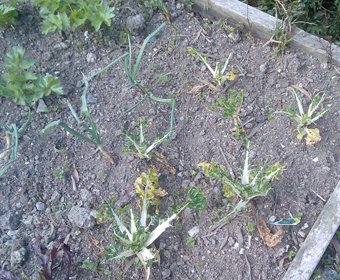
The state of the silverbeet after Sparrow and the gang left town.
Neddy Poindexter, the 14-year-old hero of The Scarecrow, Ronald Hugh Morrieson’s gothic tale of life and crime in small-town New Zealand, was right all along: the chickens are the miscreants.
And they’re on a spree.
Most of the trouble starts with Sparrow and The Other One, two chicks hatched as loveable balls of brown fluff in January, but who are now fully fledged young hoons.
Bruce, their father, is a kind and patient rooster who is willing to let the boys live at home, up to a point. The deal is, they can sleep in the henhouse and eat with the flock (after everyone else is finished of course) but the rest of the time they can sow their wild oats elsewhere.
The lads interpret Bruce’s instructions by getting up before any other bird in the neighbourhood and holding a crow-off under our bedroom window. Now I rather like the sound of roosters – they’re full of pride and irrepressible joy, and listening to a rooster is a darn sight better than listening to endless cars and other people’s radios, which was what we woke up to in the city.
And roosters are useful too; if I wake up in the dark and want to know if it’s worth thinking about getting up, I listen out for Bruce; if he’s not greeting the dawn, it’s safe to roll over and go back to sleep.
But Bruce would never dream of crowing before 5am. These guys, on the other hand, are out testing their lungs as early as 2.
For all that – and the ruckus they cause by chasing the hens when Bruce isn’t looking – I have been strangely reluctant to get rid of them. Their two older brothers, strapping big golden-brown boys we called The Wavers (crosses between Wyandottes and shavers) left this world some time ago. But Bruce and The Other One got a stay-of-execution on the ground that they’re a heritage breed (Golden Wyandottes) and we could probably find a home for them. The real reason was that I could face only so much blood in one day, and I am rather fond of these two; The Other One because he’s a gentle guy despite his youth, and Sparrow because we watched him hatch.
I’m not the first one to complain about the destruction chooks can do in a vege garden, and I won’t be the last. We learnt the hard way, seeing hours of work and next season’s greens disappear in a matter of minutes. So we set up systems to deal with the foraging nature of chooks; they now live in their own paddock surrounded by an electric net, well out of harm’s way. We still let them out for short walks in the orchard, but only when Cody, the spaniel, is stationed by the vegetable beds to see off raiders.
The netting worked so well that we needed to have it live for only a few days for most of the chooks to learn to keep away from it. But Sparrow and The Other One, like young males everywhere, are no respecters of boundaries, and simply fly right over it (something the suppliers assured us chooks couldn’t do).
What’s worse, they’ve initiated two of the younger hens into their gang, and the four of them strut round the place all day as if they own it. The bed of peas we planted on the lawn near the office fell victim early on, as have flower beds and the strawberries. But the beds of leafy greens right next to the house have been safe, thanks to Cody’s watchful presence. If any chook steps past the clothesline, he’s off the deck and barking madly until the offenders retreat into no-man’s land under the tangelo trees.
But no dog can be on duty 24/7, and with Tuesday afternoon so warm and sunny that we were down to tee-shirts, we took Cody for a short walk by the river.
Not short enough, however; we returned to find The Gang of Four living it up on our veges. They retreated rapidly with a cocker spaniel up their backsides, but the damage was done. The cabbages are decapitated, the mizuna has disappeared, and the silverbeet is reduced to silver stalks poking up at the sky. They even pulled out some of the wee red onions, and they don’t even like onions.
It’s fair to say that I was angry, and threatened them with all sorts of murderous things. They seemed to sense my mood, and kept out of my way for a while. It was the silverbeet I was most upset about; it is one of the mainstays of our spring diet, and I’d been planning to use some that night to make a quiche. Ironically, it’s also our main source of supplementary greens for the chooks at this time of year, when there’s hardly any comfrey around.
By Thursday I had calmed enough for things to return to normal; Sparrow, The Other One, Gwen and Laila have the run of the place again and are risking quick raids on the garden.
But the universe has a funny way of righting imbalance. On Thursday afternoon, a local lady who likes our unsprayed garlic rang to say she was coming to get some, and asked whether we had any spare eggs. Egg-selling is Tom’s main pocket-money activity, so I told her I could let her have half a dozen. She popped around to pick them up, in the back of her wee car were two bags stuffed full of silverbeet – one for us and one for the chooks.
*Sadly, The Scarecrow, by Ronald Hugh Morrieson, is no longer in print.
Tags: chooks, gardening, gentleworld, Morrieson, Scarecrow