The Miscreants

September 19th, 2008


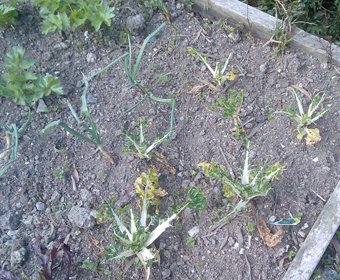
The state of the silverbeet after Sparrow and the gang left town.

The state of the silverbeet after Sparrow and the gang left town.


Neddy Poindexter, the 14-year-old hero of The Scarecrow, Ronald Hugh Morrieson’s gothic tale of life and crime in small-town New Zealand, was right all along: the chickens are the miscreants.


And they’re on a spree.


Most of the trouble starts with Sparrow and The Other One, two chicks hatched as loveable balls of brown fluff in January, but who are now fully fledged young hoons.


Bruce, their father, is a kind and patient rooster who is willing to let the boys live at home, up to a point. The deal is, they can sleep in the henhouse and eat with the flock (after everyone else is finished of course) but the rest of the time they can sow their wild oats elsewhere.


The lads interpret Bruce’s instructions by getting up before any other bird in the neighbourhood and holding a crow-off under our bedroom window. Now I rather like the sound of roosters – they’re full of pride and irrepressible joy, and listening to a rooster is a darn sight better than listening to endless cars and other people’s radios, which was what we woke up to in the city.


And roosters are useful too; if I wake up in the dark and want to know if it’s worth thinking about getting up, I listen out for Bruce; if he’s not greeting the dawn, it’s safe to roll over and go back to sleep.

But Bruce would never dream of crowing before 5am. These guys, on the other hand, are out testing their lungs as early as 2.


For all that – and the ruckus they cause by chasing the hens when Bruce isn’t looking – I have been strangely reluctant to get rid of them. Their two older brothers, strapping big golden-brown boys we called The Wavers (crosses between Wyandottes and shavers) left this world some time ago. But Bruce and The Other One got a stay-of-execution on the ground that they’re a heritage breed (Golden Wyandottes) and we could probably find a home for them. The real reason was that I could face only so much blood in one day, and I am rather fond of these two; The Other One because he’s a gentle guy despite his youth, and Sparrow because we watched him hatch.


I’m not the first one to complain about the destruction chooks can do in a vege garden, and I won’t be the last. We learnt the hard way, seeing hours of work and next season’s greens disappear in a matter of minutes. So we set up systems to deal with the foraging nature of chooks; they now live in their own paddock surrounded by an electric net, well out of harm’s way. We still let them out for short walks in the orchard, but only when Cody, the spaniel, is stationed by the vegetable beds to see off raiders.


The netting worked so well that we needed to have it live for only a few days for most of the chooks to learn to keep away from it. But Sparrow and The Other One, like young males everywhere, are no respecters of boundaries, and simply fly right over it (something the suppliers assured us chooks couldn’t do).


What’s worse, they’ve initiated two of the younger hens into their gang, and the four of them strut round the place all day as if they own it. The bed of peas we planted on the lawn near the office fell victim early on, as have flower beds and the strawberries. But the beds of leafy greens right next to the house have been safe, thanks to Cody’s watchful presence. If any chook steps past the clothesline, he’s off the deck and barking madly until the offenders retreat into no-man’s land under the tangelo trees.


But no dog can be on duty 24/7, and with Tuesday afternoon so warm and sunny that we were down to tee-shirts, we took Cody for a short walk by the river.


Not short enough, however; we returned to find The Gang of Four living it up on our veges. They retreated rapidly with a cocker spaniel up their backsides, but the damage was done. The cabbages are decapitated, the mizuna has disappeared, and the silverbeet is reduced to silver stalks poking up at the sky. They even pulled out some of the wee red onions, and they don’t even like onions.


It’s fair to say that I was angry, and threatened them with all sorts of murderous things. They seemed to sense my mood, and kept out of my way for a while. It was the silverbeet I was most upset about; it is one of the mainstays of our spring diet, and I’d been planning to use some that night to make a quiche. Ironically, it’s also our main source of supplementary greens for the chooks at this time of year, when there’s hardly any comfrey around.


By Thursday I had calmed enough for things to return to normal; Sparrow, The Other One, Gwen and Laila have the run of the place again and are risking quick raids on the garden.


But the universe has a funny way of righting imbalance. On Thursday afternoon, a local lady who likes our unsprayed garlic rang to say she was coming to get some, and asked whether we had any spare eggs. Egg-selling is Tom’s main pocket-money activity, so I told her I could let her have half a dozen. She popped around to pick them up, in the back of her wee car were two bags stuffed full of silverbeet – one for us and one for the chooks.


*Sadly, The Scarecrow, by Ronald Hugh Morrieson, is no longer in print.


Ode to the potato

July 22nd, 2008
Jersey bennies, chitting happily in the greenhouse.

Jersey bennies, chitting happily in the greenhouse.

 Legend has it that my ancestors, besieged by warring Maori, were forced to eat the Read the rest of this entry »

Forecasting spring

June 22nd, 2008

narcisis.jpg

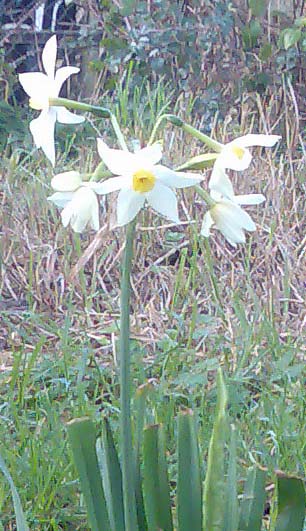
The winter solstice and a lone spring flower stands sentry at the edge of the old orchard.

Paperwhites are narcissus by name and by nature. This one has been tricked by two weeks of mild weather (daytime 20, night-time 10) into arriving five weeks too early for the spring carnival. It doesn’t realise that it’s all down-hill from here.

June is the start of the year for the Southern Hemisphere gardener. As the growing season runs down and we eat the last of the autumn crops, the year comes to a natural full-stop. Even here in the Winterless North. Sure, we mightn’t be under snow and we might be down to tee-shirts on sunny afternoons, but nature is telling us that now, the shortest day of the year, is time to stop and take stock.

Ahead is the short sharp winter that sees us pulling jerseys out of storage and throwing frost protection over our most tender plants, but for now we’re thinking about the year ahead.

A few weeks back I sat down and made a list of all the things that we can grow here to eat in winter. It is 50 items long. And while I’m pushing it to claim even 10 per cent of that list is coming out of my garden this year, it made me realise how fortunate I am to garden in an area with a 12-month growing season. The American and English books I’ve spent the last two months studying as I draw up my garden plan are based on six-month seasons at the most. Even my New Zealand-based sister is far more limited in the winter crops she can grow in her North Canterbury garden.

The down side of our year-round bounty is that we never really stop gardening. Our seasons overlap. This week I’ve been feeding winter crops like broccoli and cabbages with vermicast and planting out silverbeet (Swiss chard) seedlings, while pricking out lettuces and sowing next summer’s onions. The broad (fava) beans in trays in the greenhouse are up, as are the peas sown into the kumara bed two weeks ago.

But not this weekend. Gardening activities have been limited to ordering kiwifruit vines to plant on the chook run (Hayward and Arguta females and a Chieftain male) and sitting in the sun, surrounded by books, seed packets and my garden diary, appreciating the food we’ve had over the past year and anticipating the crops to come.

Next week we start planting the garlic, and in a month I will put in the first seed potatoes, confident that the frosts will be over by the time they push their shoots up into the August sunshine.  Then it’s into the hard work of preparing the beds for spring planting. Between now and then I have to work out how many plants its takes to keep a family of three in potatoes, greens and other crops, how much ground they will need and get the seedlings germinated and growing.

From where I sit at the moment it’s all a bit daunting. It’s one thing to grow half-a-dozen lettuces and a few stalks of silverbeet; it’s another to anticipate and provide your family’s food for the year. So for now I’m patting myself on the back for the successes of the past year – my first crop of potatoes, my first crop of kumara, the best broccoli and cabbages I’ve ever tasted, and some summer fruit put away in the pantry in the form of jams, chutneys and dried fruits.

And as I look past the tangelo trees and  their ripening bounty into the old orchard I can’t help but raise a mental toast to the paperwhite whose sense of self is so strong that it doesn’t care whether it’s ahead of its time or not.

It takes courage to go your own way, and I hope I have enough of it.

My new life as a peasant

June 13th, 2008

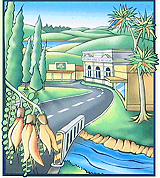
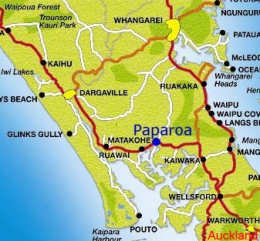
Paparoa - the village in the valley, and home for our new life 

Self-sufficiency was a bit of a game until poverty hit us between the eyes. Now, with sky-rocketing fuel prices and warnings of a world food crisis, it’s deadly serious.

In late 2005 we fled our two-storeyed home in suburban Auckland, New Zealand, to live in our cottage on the edge of the Kaipara Harbour. There was lots of grand talk about a better life and living lighter on the planet, but the truth is that I was sick of corporate life. I wanted to grow veges and keep chooks.

We got the chooks and planted some vegetables and for a year-and-a-half generally indulged my Thomas-Hardy fantasies.

But we didn’t take it seriously; survival still meant cash. If we didn’t get a crop in, it didn’t matter because there was always food at the store.

Then one day I realised that I had to garden as if our lives depended on it if I wanted it to work. And as our money ran low and it became clear how much harder it is to get well-paid work in rural areas, I started to see how our lives might really depend on our land.

In April 2008 I decided to work out what food we really need and to produce as much of it as we can. 

Our resources are limited; one-and-a-bit acres of hilly clay-country and not a lot money. And we still have to devote far too much time to earning a conventional living if we are to pay the bills that relentlessly dog modern life, even in a rural idyll.

On the plus side, we work at home and can usually find an hour or two scattered through the day to tend our land and livestock. And we have land, albeit mortgaged and in need of work.

But our truly big advantage is that we live in a community where it is still normal to produce your own food. Most of our neighbours – even those who don’t farm for a living – make jam and have fruit trees in the garden. And as I write this, I can hear half the village partying at the local pub in celebration of the annual pig hunt. 

What follows are the ups and downs of trying to live a little more independently and a little more lightly on the Earth. This is not one of those “year-of” stories, in which the particpants dramatically promise to eat their our own produce or perish. We are not that brave, and my husband and son are not that tolerant.

What we are is an ordinary family doing our best to feed and look after ourselves in a way that was once extremely ordinary.

 Welcome to my new life as a peasant.